1 University of Illinois Urbana-Champaign
Building capable visual web agents requires long-horizon reasoning, precise grounding, and robust interaction with dynamic real-world websites. Despite rapid progress, the strongest systems remain largely proprietary, while open agents still depend heavily on supervised post-training over large collections of curated web trajectories. This dependence creates a major scalability bottleneck: high-quality demonstrations are expensive to collect, and static datasets offer limited coverage of the diverse, ever-changing open web.
We introduce OpenWebRL, an open framework for training visual web agents with online multi-turn RL on real websites. OpenWebRL covers the full training pipeline, including scalable live-browser infrastructure, supervised initialization, multimodal context management, trajectory-level success judging, and efficient multi-turn policy optimization.
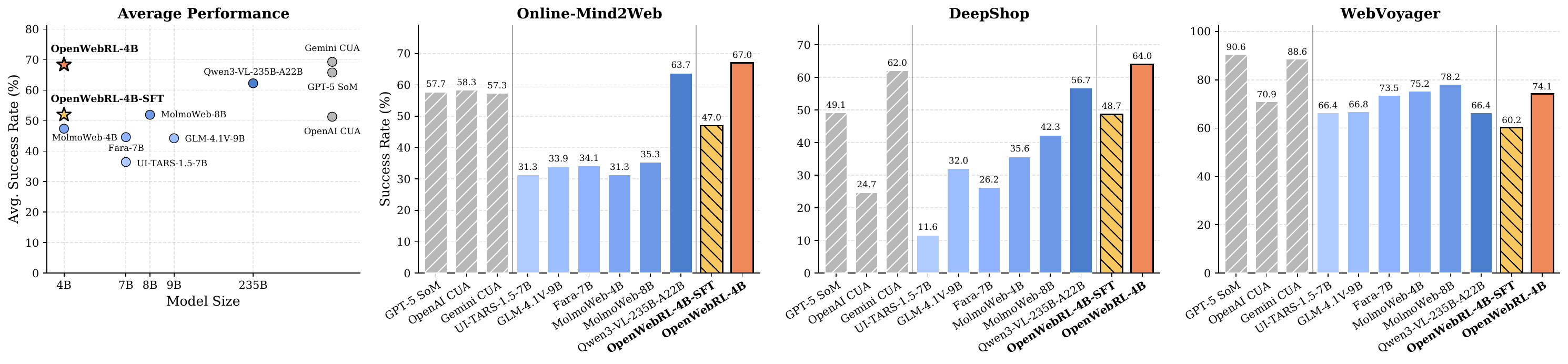
Using this framework, we train OpenWebRL-4B, which establishes a new open-source state of the art on challenging live-web benchmarks. With only 0.4K initialization trajectories and 2.2K open-ended RL training tasks, OpenWebRL-4B achieves 67.0% success on Online-Mind2Web and 64.0% on DeepShop, outperforming prior open agents of similar or larger scale and remaining competitive with proprietary systems including OpenAI CUA and Gemini CUA. Beyond strong benchmark performance, we systematically study the key design choices that make online RL effective for visual web agents, and analyze how RL improves agentic reasoning during training.

Warm-starts the policy with only 0.4K high-quality trajectories collected from Qwen3-VL-235B, placing it in a productive exploration regime before online RL — eliminating cold-start instability with minimal data.
A fault-tolerant live-browser environment with 13 atomic browser tools, a multi-tool-call interface, and textual environment feedback — making open-web rollouts reliable and efficient at scale.
Retains only the most recent screenshot (K=1) for visual grounding while preserving full reasoning traces as long-horizon textual memory — balancing performance and training cost.
MM-GRPO propagates a single trajectory-level reward to all assistant tokens across all turns, using the same context-management procedure for both rollout and optimization. Combined with asymmetric clipping and trajectory-level dynamic sampling for stable optimization.
A distilled 8B judge trained on 12.5K rollouts achieves 89.8% accuracy / 92.1% F1 against GPT-4.1, matching proprietary quality while cutting ~$545 per training run.
Trains first with 15-step horizons then extends to 30 steps — short horizons stabilize early exploration, longer horizons enable the policy to handle tasks requiring extended interactions.
Official success rates (%) on three live-web benchmarks. * from FARA · † from MolmoWeb · Bold = best · Underline = second best.
| System | # Steps | # Tasks | WebVoyager | Online-Mind2Web | DeepShop | Average |
|---|---|---|---|---|---|---|
| Proprietary Models | ||||||
| GPT-5 (Axtree) † | 30 | — | 70.6 | 41.9 | 40.7 | 51.1 |
| Gemini-3-Flash (Axtree) † | 30 | — | 74.4 | 34.8 | 45.1 | 51.4 |
| Gemini-3-Flash (Axtree) † | 100 | — | 85.6 | 44.8 | 55.3 | 61.9 |
| GPT-4o (SoM) * | 100 | — | 65.1 | 34.6 | 16.0 | 38.6 |
| o3 (SoM) * | 100 | — | 79.3 | 55.4 | 49.7 | 61.5 |
| GPT-5 (SoM) * | 100 | — | 90.6 | 57.7 | 49.1 | 65.8 |
| OpenAI CUA * | 100 | — | 70.9 | 58.3 | 24.7 | 51.3 |
| Gemini CUA † | 100 | — | 88.6 | 57.3 | 62.0 | 69.3 |
| Open-Source Models | ||||||
| Holo1-7B † | 30 | >15.6K | 55.4 | — | — | — |
| UI-TARS-1.5-7B * | 100 | — | 66.4 | 31.3 | 11.6 | 36.4 |
| GLM-4.1V-9B-Thinking * | 100 | — | 66.8 | 33.9 | 32.0 | 44.2 |
| FARA-7B * | 100 | >123.2K | 73.5 | 34.1 | 26.2 | 44.6 |
| MolmoWeb-4B † | 100 | >278.5K | 75.2 | 31.3 | 35.6 | 47.4 |
| MolmoWeb-8B † | 100 | >278.5K | 78.2 | 35.3 | 42.3 | 51.9 |
| Qwen3-VL-4B-Thinking | 30 | — | 52.6 | 32.0 | 33.3 | 39.3 |
| Qwen3-VL-235B-A22B-Thinking | 30 | — | 66.4 | 63.7 | 56.7 | 62.3 |
| Ours (Qwen3-VL-4B Backbone) | ||||||
| OpenWebRL-4B-SFT | 30 | 0.4K | 60.2 | 47.0 | 48.7 | 52.0 |
| OpenWebRL-4B | 30 | 2.2K | 74.1 | 67.0 | 64.0 | 68.4 |
| OpenWebRL-4B w/ Judge-8B | 30 | 2.2K | 68.9 | 67.3 | 68.7 | 68.3 |
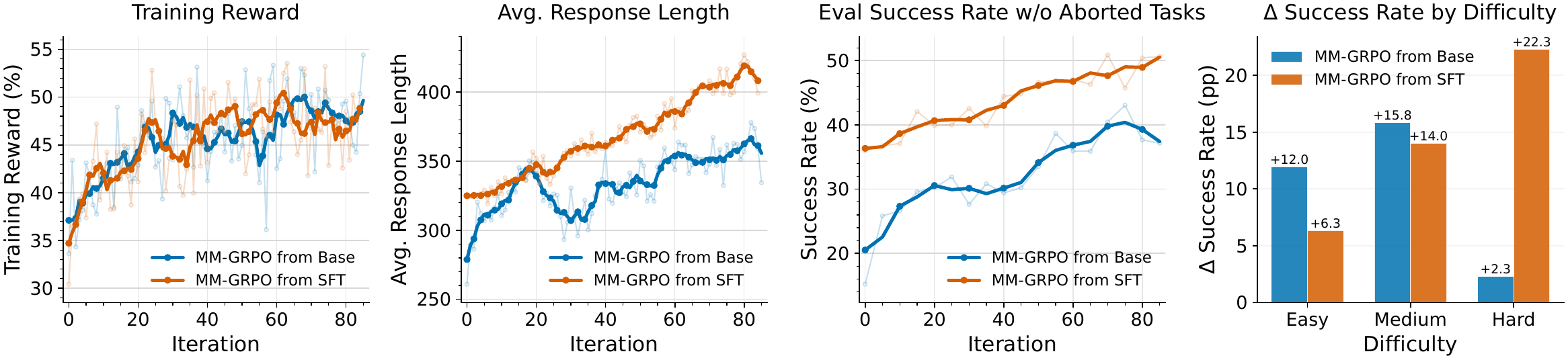
Does supervised warm-start help online RL?
Comparison of MM-GRPO training from SFT and base-model initializations. (a) Average training reward. (b) Average response length. (c) Evaluation success rate (excl. aborted). (d) Success rate improvement by difficulty split on Online-Mind2Web.
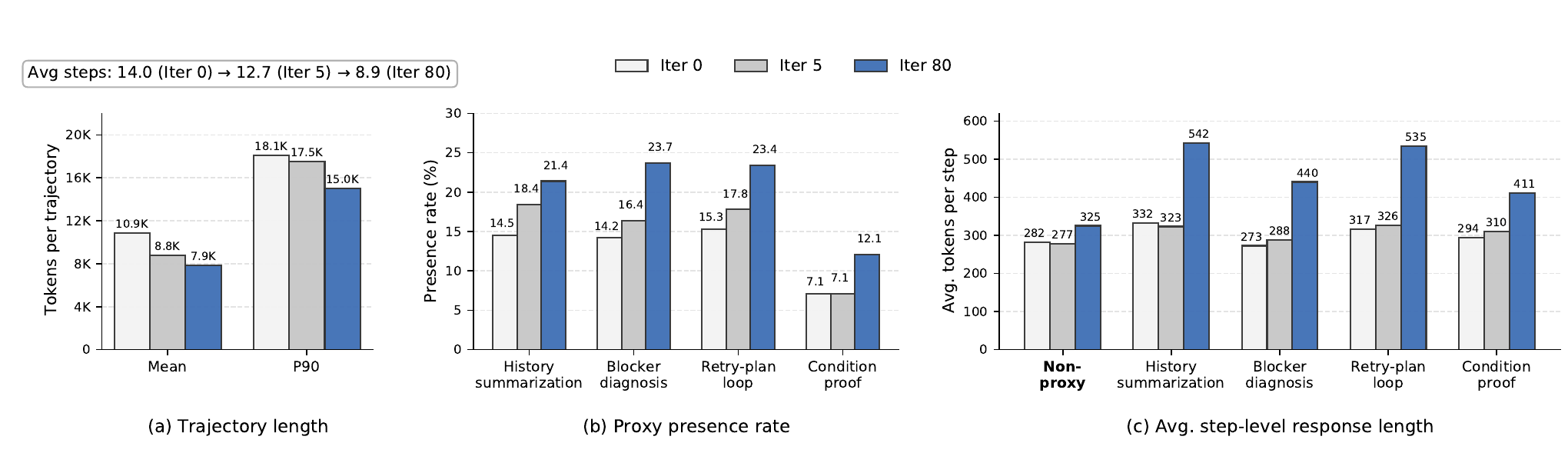
How does RL reshape the agent's reasoning patterns?
Diagnosing response-length growth during MM-GRPO. (a) Trajectory length and average interaction steps. (b) Step-level proxy presence rates. (c) Average step-level response length conditioned on reasoning pattern type.
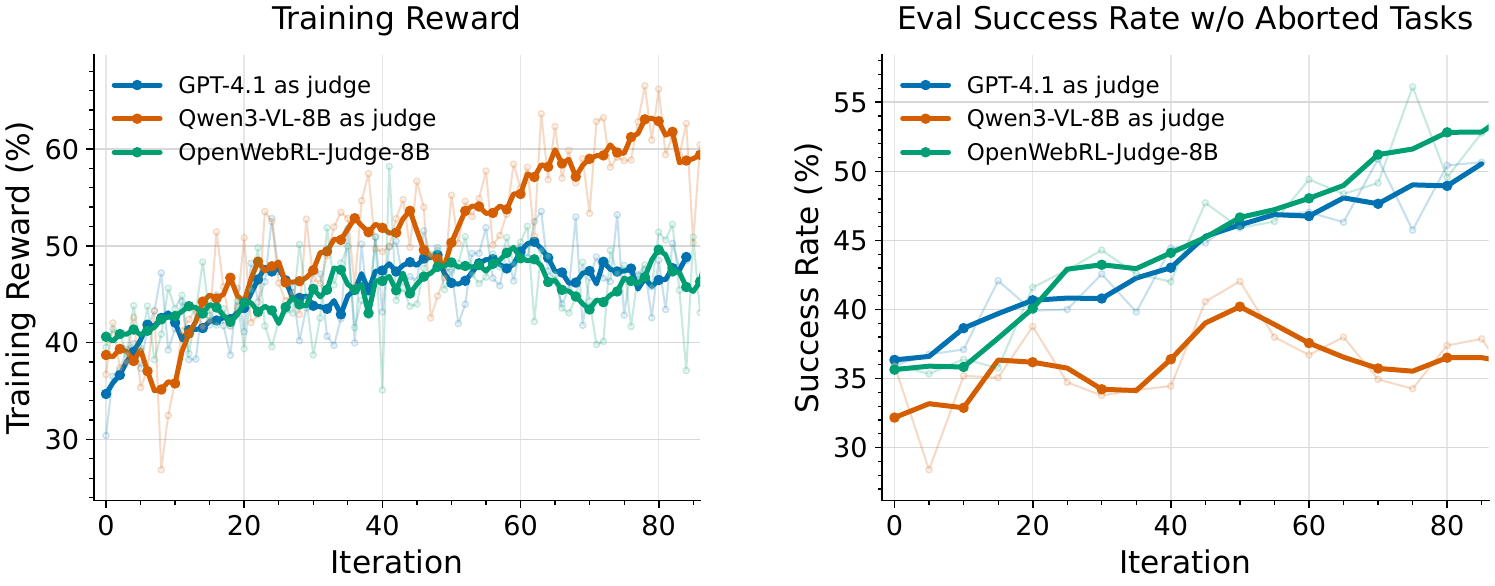
Does the judge model matter for RL stability?
RL training curves with GPT-4.1, OpenWebRL-Judge-8B, and the base VLM as judge.
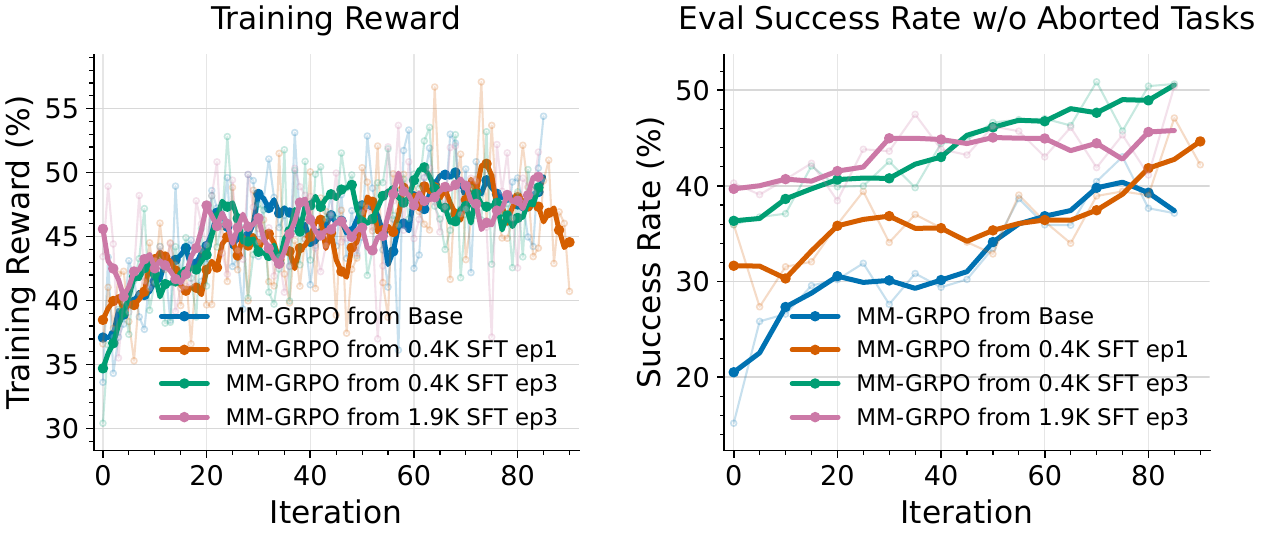
How much does the quality of SFT initialization matter?
MM-GRPO from different SFT initializations on Online-Mind2Web.
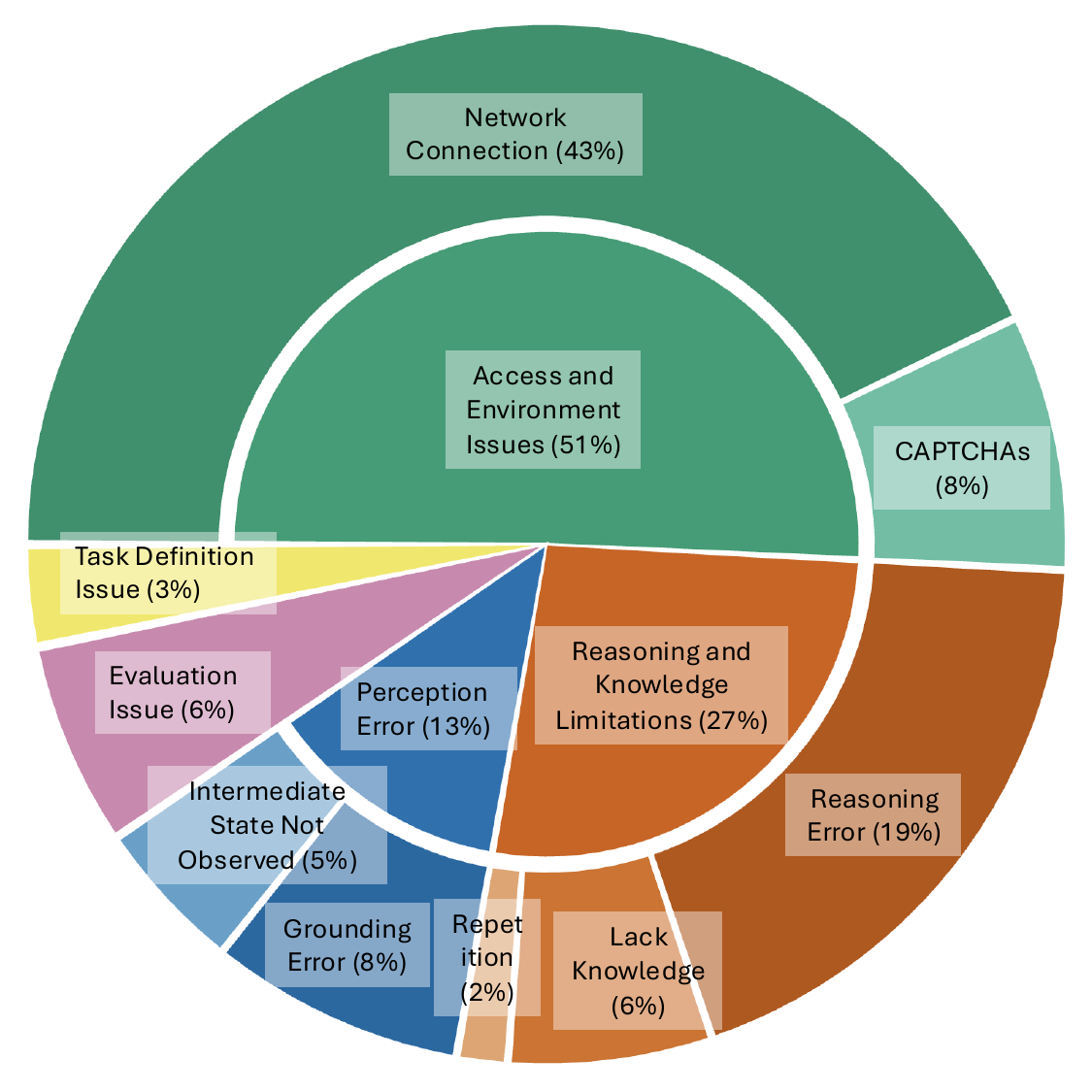
What causes failures on live websites?
Distribution of failure modes based on manual inspection of 100 failed trajectories sampled from failed cases on Online-Mind2Web, evaluated without Browser-Use Stealth Browser service (raw open-web setting).